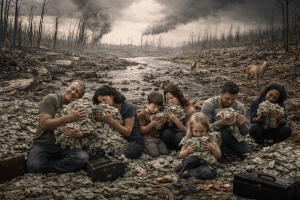
There is a story running quietly in the background of modern life.
It tells us that capitalism is imperfect, but inevitable.
That its failures are side effects, not features.
That with enough regulation, innovation, or responsibility, it can be renewed.
This story feels like common sense — not because it is true, but because it has never been properly questioned.
Capitalism does not merely misuse value.
It is structurally incapable of sustaining it.
Capitalism’s Core Logic
At its heart, capitalism is not an economic system of value creation.
It is a system of capital accumulation.
Capital must:
- grow,
- concentrate,
- and reproduce itself faster than its competitors.
Everything else — labor, nature, knowledge, relationships, even time — is subordinated to this requirement.
Value matters only insofar as it can be:
- captured,
- priced,
- owned,
- and converted into capital.
This is not a moral failure.
It is a design principle.
Why “Better Capitalism” Is a Contradiction
Attempts to reform capitalism usually focus on symptoms:
- inequality,
- environmental damage,
- worker precarity,
- short-termism.
But these are not deviations.
They are logical outcomes.
Capitalism treats:
- ecosystems as externalities,
- people as cost centers,
- communities as markets,
- and the future as discounted cash flow.
Any system optimized for accumulation will:
- extract faster than it can regenerate,
- concentrate faster than it can redistribute,
- and deplete faster than it can renew.
To ask capitalism to regenerate is to ask it to violate its own operating logic.
The Hidden Problem: Static Value
Even when capitalism speaks the language of “value,” it treats value as static:
- value is created once,
- captured once,
- and owned once.
From that moment on, it can be hoarded, leveraged, or enclosed.
Capital can survive without circulation.
Value can not.
When value stops circulating:
- systems hollow out,
- trust erodes,
- resilience collapses.
Capitalism solves this not by restoring circulation, but by accelerating extraction elsewhere.
Why Capital Must Be Replaced, Not Rebranded
Replacing capital with ethics, purpose, or stakeholders does not change the core logic.
It merely decorates it.
As long as capital remains the organizing principle:
- value will be subordinated,
- regeneration will be optional,
- and sustainability will remain conditional.
The issue is not how we grow, but what we have chosen to center.
Capital is a means. Capitalism made it the end.
From Capital to Value — and Beyond
The necessary shift begins by recentring the system around value, not capital.
But value alone is not enough.
Value that does not move stagnates.
Value that does not return depletes.
Value that does not regenerate collapses into abstraction.
This is why Valueism must evolve.
Revalueism: The Missing Step
Revalueism (Regenerative Valueism) begins where capitalism — and even Valueism — fall short.
It asserts that:
- value is not something to be accumulated,
- but something to be continuously re-evaluated,
- circulated across the system,
- and regenerated at its sources.
In Revalueism:
- value is only legitimate if it sustains the system that enables it,
- success is measured by continuity, not accumulation,
- and economic activity is judged by its regenerative balance, not its growth rate.
This is not an improvement of capitalism. It is a replacement of its core logic.
A Threshold
The future will not be determined by those who optimize capital best,
but by those who understand that value is alive.
Capitalism taught us how to extract.
Revalueism asks whether what we extract can endure.
Our upcoming book, Business Regenerated, begins here — at the moment where we stop trying to fix a system designed to deplete, and start designing one that can sustain life, work, and meaning over time.
What is Value?
But I noticed you’re thinking: what is value?
Value is the capacity of a system to sustain and enhance life, now and over time.
That’s the shortest definition that holds under pressure.
But to really see it, we need to dismantle a few inherited assumptions.
What is Value is Not
Value is not:
- money
- price
- profit
- preference
- perception
- exchange
- alone
Those are representations of value, not value itself.
Money is a claim on value.
Price is a signal of value (often distorted).
Profit is a residual after extraction.
Capitalism confused the map for the territory.
What Value Actually Consists of
Value emerges when something contributes to the viability of a larger system.
That contribution can take many forms:
- nourishment (food, clean water, fertile soil)
- capability (skills, knowledge, learning)
- coherence (trust, relationships, meaning)
- resilience (diversity, redundancy, adaptability)
- regeneration (restoration of depleted sources)
In short:
Value is whatever increases a system’s ability to continue, adapt, and thrive.
Why Capitalism Couldn’t Define Value
Because once you define value this way, three things become unavoidable:
- Value is relational
It exists between actors and systems, not inside isolated assets. - Value is temporal
What creates value today but destroys tomorrow is not value — it’s debt. - Value is conditional
It only exists if the sources it draws from are maintained or restored.
Capitalism cannot accept these conditions — because capital accumulation ignores all three.
Value vs Capital (The Fault Line)
Here’s the fracture point our whole work stands on:
- Capital can grow while systems decay.
- Value can not.
Capital tolerates:
- soil exhaustion,
- human burnout,
- ecosystem collapse,
- social fragmentation.
Value does not survive them.
That’s why capital became dominant: it is indifferent to consequences.
And that’s why it must be replaced.
The Revalueist Definition (Canonical)
Value is the net regenerative contribution an activity makes to the living systems that enable it.
If an activity generates profit but reduces future capacity to create value, it is not value creation — it is value extraction.
Why This Definition Changes Everything
Once value is defined this way:
- circulation becomes mandatory,
- regeneration becomes measurable,
- hoarding becomes pathological,
- growth becomes contextual,
- success becomes systemic, not individual.
Now, Revalueism is no longer ideological.
It becomes necessary.