
Reframing Value Creation Around Intent, Circulation, and Regeneration
For more than half a century, the Value Chain has shaped how organizations think about value creation. It frames business as a linear sequence of activities that convert inputs into outputs, optimize efficiency, and ultimately maximize profit.
While effective in an industrial, resource-abundant era, the value chain rests on assumptions that no longer hold:
- that resources are inert and endlessly available,
- that value is created inside organizational boundaries,
- that profit extraction is a legitimate primary objective.
Most critically, the value chain never explains what initiates value creation in the first place. It starts with “inputs” already given and ends with “outputs” already claimed. Agency, intent, and systemic impact are treated as externalities.
In a world of ecological limits, social fragility, and increasing interdependence, this framing has become not only insufficient, but actively harmful.
What we need instead is a shift from linear value extraction to regenerative value participation.
Value does not begin with production — it begins with intent
- an unfulfilled need,
- a tension or inefficiency in the system,
- a new insight or perspective,
- a speculative idea,
- or a sensed opportunity to improve what already exists.
Value Attractors: why actors move the way they do
Every value ecosystem contains Value Attractors — forces that pull actors in certain directions.
These may include:
- profit expectations,
- power and control,
- efficiency pressures,
- growth incentives,
- attention and visibility,
- regulatory or financial constraints.
In shareholder-primacy systems, profit becomes the dominant attractor. Other forms of value — social, ecological, relational — are subordinated or ignored unless they directly support financial gain.
Value Attractors do not determine outcomes on their own, but they shape intent. They influence whether engagement with value flows becomes extractive or regenerative.
Value Flows as accumulated surplus
Value does not originate from nothing.
It accumulates and circulates.
Every interaction between value actors leaves behind value surplus:
- financial capital,
- knowledge and insight,
- trust and relationships,
- cultural meaning,
- infrastructure and capability.
These surpluses form Value Flows — living streams of potential moving through economic and social systems.
When Value Actors engage, they do not “take resources” from a void. They tap into existing value flows, created by prior contributions.
This is a fundamental shift in perspective:
- value is not produced in isolation,
- it is recombined, transformed, and propagated.
Innovation as value transformation
Innovation is often portrayed as invention or disruption. In a regenerative context, innovation is something more precise: Innovation is the transformation of value into new forms of value.
Examples:
- knowledge transformed into insight,
- insight into capability,
- capability into trust or relevance,
- trust into long-term economic viability.
This transformation can occur in two radically different ways:
Extractive creation (Value Chains)
- captures value without replenishing flows,
- degrades trust, resilience, or ecosystems,
- optimizes short-term returns at long-term cost.
Regenerative transformation (Value Cycles)
- enriches value flows,
- increases systemic resilience and adaptability,
- creates multiple forms of return across the ecosystem.
The difference is not intention alone — it is what happens to value after transformation.
Circulation: the condition for regeneration
Value that does not circulate stagnates.
Value that circulates without enrichment erodes.
Regenerative value systems depend on distribution — the ability for transformed value to move, be reused, recombined, and amplified by others.
Linear value chains tend to:
- concentrate value,
- restrict circulation,
- and externalize costs.
Regenerative value cycles do the opposite:
- they allow value to travel,
- they invite participation,
- they multiply surplus rather than hoard it.
This is why regeneration cannot occur without deliberate circulation.
The full Value Regeneration Cycle
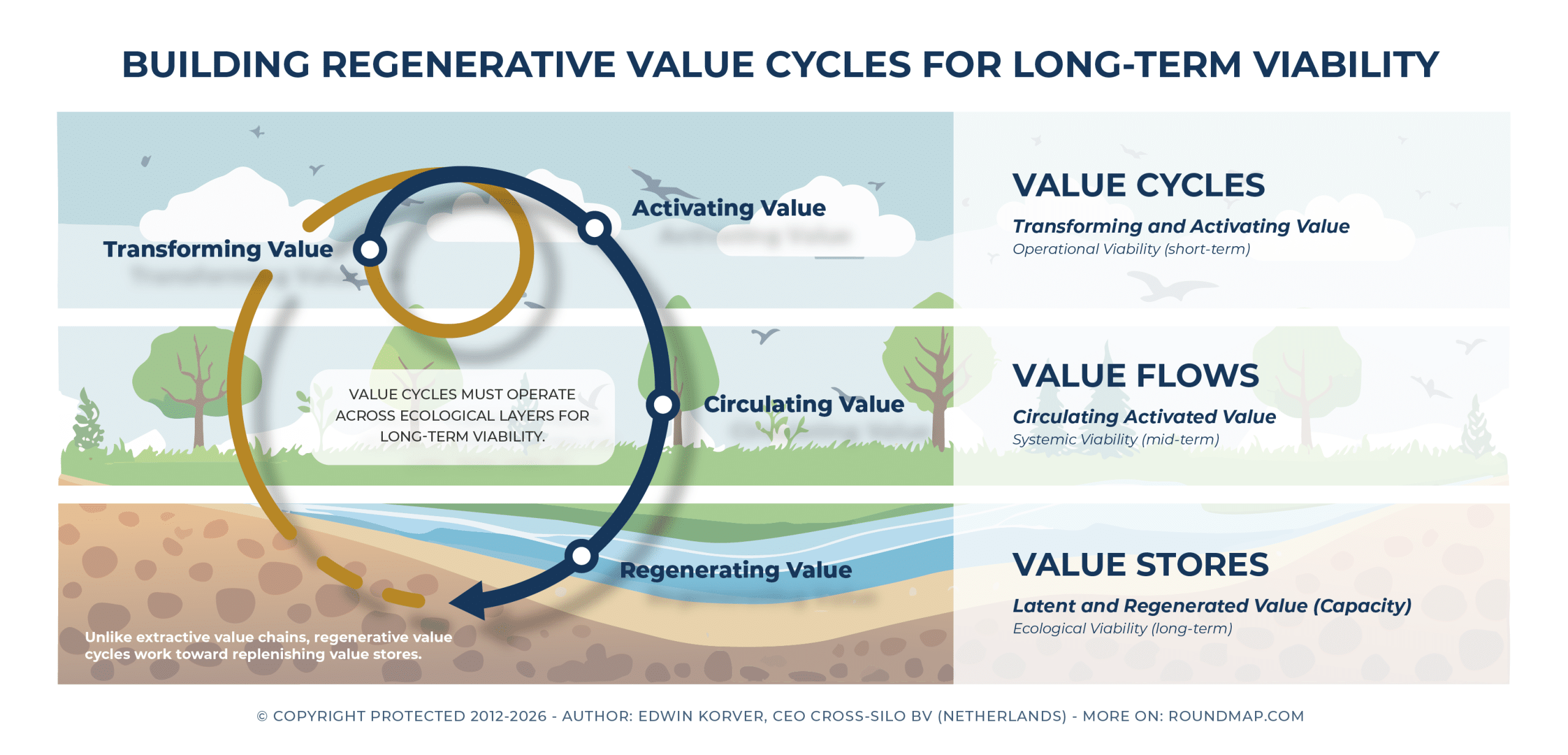
Value regeneration is not a phase, nor a final outcome. It is the emergent pattern that arises when value is intentionally engaged, transformed, circulated, and returned in ways that strengthen the ecosystem rather than deplete it. Rather than describing a linear progression, value regeneration unfolds as a continuous cycle in which contribution and return are structurally linked.
The Value Regeneration Cycle consists of the following interconnected steps:
→ Intentional engagement
A Value Actor enters the system in response to an unmet need, a new insight, or a perceived opportunity to contribute. This moment introduces agency and intent into the system and marks the beginning of the cycle—not value creation itself, but the decision to engage responsibly with what already exists.
→ Alignment with attractors
Every engagement is shaped by Value Attractors such as profit expectations, growth pressure, legitimacy, trust, purpose, or survival. These attractors steer behavior and determine whether the actor reinforces extractive dynamics or helps counterbalance them with regenerative intent.
→ Tapping into existing Value Flows (= Value Activation)
Value is never created from nothing. Through Value Activation, existing Value Flows—accumulated surpluses of knowledge, relationships, capital, infrastructure, and meaning, across ecosystems—are intentionally accessed. This step acknowledges that value creation always builds upon prior contributions within the ecosystem.
→ Transformation through innovation (= Value Transformation)
Activated value is transformed through innovation. Existing value is recombined, adapted, or enriched into new forms that increase usefulness, relevance, or resilience. Transformation is where novelty emerges, but on its own it does not guarantee regeneration.
→ Circulation through the ecosystem (= Value Circulation)
For value to become regenerative, it must circulate. Circulation allows transformed value to move through the ecosystem, be shared, reused, recombined, and amplified by others. Regenerative systems enable circulation deliberately; extractive systems restrict it to maximize capture.
→ Returns, feedback, and regeneration (= Value Regeneration)
As value circulates, it generates Returns—profit, trust, insight, legitimacy, learning, and resilience. These returns are not rewards granted by the system; they are signals that regeneration is occurring. When reinvested, they enrich the value flows themselves, enabling future rounds of activation and elevating the system’s overall capacity to create value.
The cyclical logic of value regeneration can therefore be described as:
Value Flows → Activation → Transformation → Circulation → Regeneration.
Regeneration is not an additional activity, but the systemic effect of value being transformed and allowed to circulate in ways that enrich the ecosystem. Economic returns (profit), trust, insight, and legitimacy arise as signals of this regenerative effect, while simultaneously reinforcing the value flows that enable the next cycle. And as a result:
- Regeneration is no longer a promise — it’s an emergent property.
- Profit is no longer the aim — it’s a signal.
- Innovation is no longer novelty — it’s value transformation.
- Value creation is no longer internal — it’s ecological.
Across repeated, learning-informed cycles, value no longer accumulates at the expense of the system. Instead, the system itself becomes healthier, more resilient, and more equitable—making regeneration not a moral add-on, but the most viable foundation for long-term value creation.
At the heart of value regeneration lies a simple but irreversible logic: value must first be activated, then transformed, and only then allowed to circulate. Returns emerge not as a goal, but as a consequence of this regenerative flow.
Why shareholder-primacy breaks the cycle
Shareholder-primacy reframes the cycle as a pipeline:
- engage only where profit is highest,
- transform value for capture,
- restrict circulation,
- extract returns upward.
This breaks feedback loops, depletes value flows, and leaves ecosystems weaker than they were before engagement.
Profit becomes detached from contribution.
Regeneration as the ultimate aim
In a regenerative value system, the objective is not profit maximization.
It is leaving the ecosystem healthier than we found it.
Profit still matters — but as a consequence of contribution, not its justification.
When value flows are enriched:
- returns become more stable,
- innovation becomes continuous,
- trust compounds,
- and economic viability aligns with systemic wellbeing.
This is not idealism. It is a structural correction.
Definition ─ A regenerative value cycle is activated by intentional engagement with existing value flows, transforms and circulates value through the ecosystem, and yields returns and feedback that inform future engagement. Regeneration emerges across repeated, enriching traversals of this cycle.
From chains to cycles
Value is no longer something organizations push through a chain.
It is something they enter, transform, circulate, and receive back.
The question is no longer:
“How much value can we extract?”
But:
“How do we participate in a way that regenerates the system we depend on?”
That is the shift from Value Chains to Value Cycles.
Executive Summary — From Value Chains to Value Cycles
Traditional business models like Porter’s Value Chain frame value creation as a linear, input-to-output process focused primarily on efficiency and profit extraction. However, this linear approach overlooks fundamental system dynamics: who initiates value creation, why they act, what makes them act the way they do, and how value actually circulates and evolves across stakeholders and ecosystems.
Value Cycles offer a more accurate, equitable, and adaptive alternative. In this model:
- Value Flows represent existing surpluses in the ecosystem — financial, relational, cognitive, cultural, and systemic — ready to be tapped and transformed.
- Value Activation is the entry point: the moment a Value Actor intentionally engages with value flows, motivated by insight, need, or opportunity. This activation sets the regenerative cycle in motion.
- Their engagement is influenced by Value Attractors — forces such as profit expectations, growth pressures, trust, legitimacy, and purpose — which shape behavior toward extractive or regenerative pathways.
Innovation is reframed as the transformation of value into new, enriched forms — with two possible pathways:
- Extractive: capturing value while depleting flows,
- Regenerative: enriching flows and strengthening systemic resilience.
A Value Cycle consists of the following sequence:
Value Flows → Value Activation → Value Transformation → Value Circulation → Value Returns (enriching flows)
Returns — profit, insight, trust, and learning — are not the goal but signals that regeneration is occurring, feeding into subsequent activations.
Unlike linear chains, regenerative cycles leave ecosystems healthier than they were before engagement. Profit and other returns emerge as consequences of meaningful contribution, aligning long-term viability with systemic resilience, stakeholder wellbeing, and continuous innovation.
The Diagram: A Living Feedback System

The diagram illustrates the logic of a Value Actor visually:
- Input (–) represents the actor’s dependency on external value surplus.
- Process represents value transformation.
- Output (+) represents value surplus created for others.
- The feedback loop shows how returns—learning, trust, insight—feed back into future value flows.
In extractive chains, this loop is broken.
In regenerative ecosystems, it is protected.
Definition ─ A Value Actor is a regenerative transformation hub that relies on incoming value surplus, transforms it through its unique capabilities, and produces outgoing value surplus for others, while learning from the feedback that returns.
The Role of Value Attractors
If value flows, what shapes its direction?
This is where Value Attractors come in.
A Value Attractor is a force within the system that pulls value toward it. Examples include:
- profit,
- power,
- attention,
- growth,
- purpose,
- legitimacy,
- regeneration itself.
In extractive systems, attractors -such as short-term profit- distort flows, pulling value upward and inward until circulation collapses.
In regenerative systems, attractors are rebalanced:
- profit remains, but no longer dominates,
- regeneration becomes a legitimate attractor,
- contribution outcompetes extraction.
Designing a regenerative system is thus largely about designing better attractors.
Definition ─ A Value Attractor is a force that shapes the direction and intensity of behavior within a value ecosystem by creating gradients of pressure that pull Value Actors toward specific outcomes—often regardless of their intentions.