Growing Resilience: The Stockdale Paradox

Growing Resilience: The Stockdale Paradox

The Stockdale Paradox, named after Admiral James Stockdale, is a concept introduced by Jim Collins in his book “Good to Great.” It refers to a crucial mindset for dealing with a crisis effectively.

The paradox stems from Admiral Stockdale’s experience as a prisoner of war in Vietnam for over seven years. When asked about the traits that helped him and others survive, he explained that it was essential to maintain two seemingly contradictory beliefs simultaneously.

First, he acknowledged the harsh reality of their situation. He faced brutal treatment, uncertainty, and the possibility of not surviving. This realistic assessment helped him confront the challenges head-on.

However, while recognizing the brutal facts, Stockdale had unwavering faith in their ultimate rescue and believed in his ability to endure the ordeal. This optimistic outlook helped him maintain hope, motivate his fellow prisoners, and ultimately survive.

The Stockdale Paradox, therefore, emphasizes the importance of confronting the harsh realities of a crisis while maintaining a positive mindset. It’s about balancing realism with hope, acknowledging the challenges, and being willing to face them while having faith in your ability to overcome and eventually prevail.

In dealing with a crisis, the Stockdale Paradox suggests that it’s essential, to be honest about your difficulties and uncertainties, yet remain optimistic and resilient. By accepting reality and maintaining hope, you can better navigate the challenges and work towards a successful resolution.

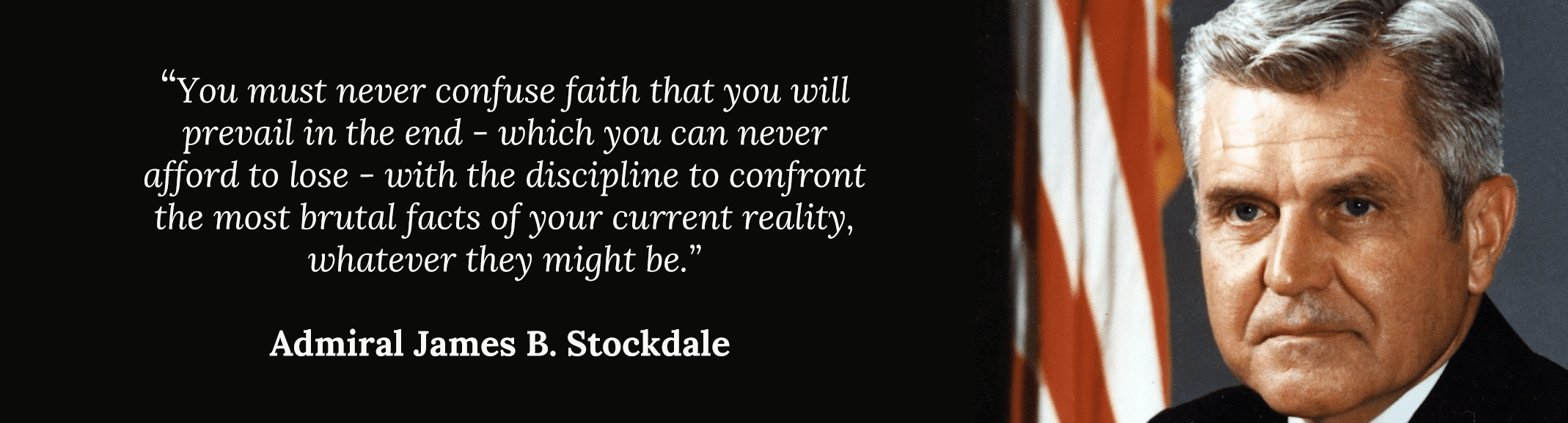
The Stockdale

Author

  • edwinkorver

    Edwin Korver is a polymath celebrated for his mastery of systems thinking and integral philosophy, particularly in intricate business transformations. His company, CROSS/SILO, embodies his unwavering belief in the interdependence of stakeholders and the pivotal role of value creation in fostering growth, complemented by the power of storytelling to convey that value. Edwin pioneered the RoundMap®, an all-encompassing business framework. He envisions a future where business harmonizes profit with compassion, common sense, and EQuitability, a vision he explores further in his forthcoming book, "Leading from the Whole."

    View all posts Creator of RoundMap® | CEO, CROSS-SILO.COM
Share the Post:

Recent Articles

licenced-by-cross-silo-shutterstock_2496390355
Shared Value Networks

Governing Value: From Extraction to Accountability in Living Systems

Why Capitalism Struggles with the Laws of Nature Economic theories such as Donut Economics, Earth Overshoot Day, and planetary boundary frameworks have made one thing abundantly clear: resources are finite, and human activity must operate within ecological limits. These models

roundmap-value-centricity-copyright-protected-2026
Capitalism

Value Centricity: A Viability Model for Business and Society

Let’s return to one of RoundMap’s foundations: the Business Model Matrix. Within it, I originally identified four foundational business models: Customer Centricity, Product Centricity, Resource Centricity, and Platform Centricity. At the time, these felt fundamental—not just to how companies operate,

Stay in the Loop!