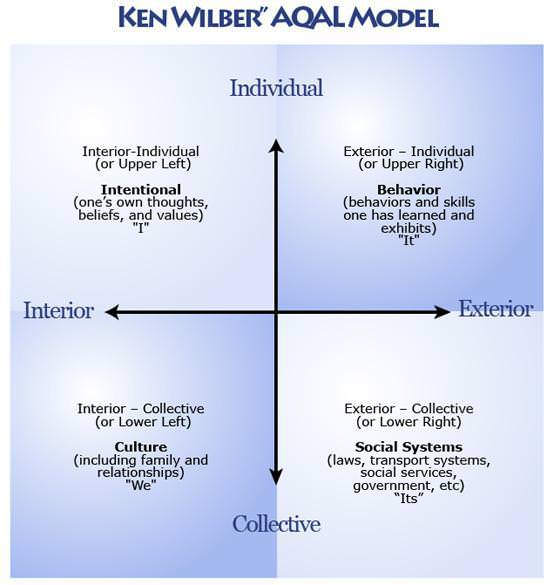
- Integral Theory and the AQAL Model: The AQAL (All Quadrants, All Levels) model is a foundational element of Integral Theory. It provides a framework for understanding the multiple dimensions of reality and how they interrelate. The AQAL model consists of four quadrants, which represent different perspectives or domains of existence:
- The “I” quadrant (Interior Individual) focuses on subjective experiences, thoughts, emotions, beliefs, and personal consciousness.
- The “We” quadrant (Interior Collective) addresses shared cultural beliefs, values, norms, and social systems.
- The “It” quadrant (Exterior Individual) encompasses individuals’ objective, observable aspects, such as their behaviors, biological processes, and physical environments.
- The “Its” quadrant (Exterior Collective) explores the collective structures, systems, and institutions that shape society.
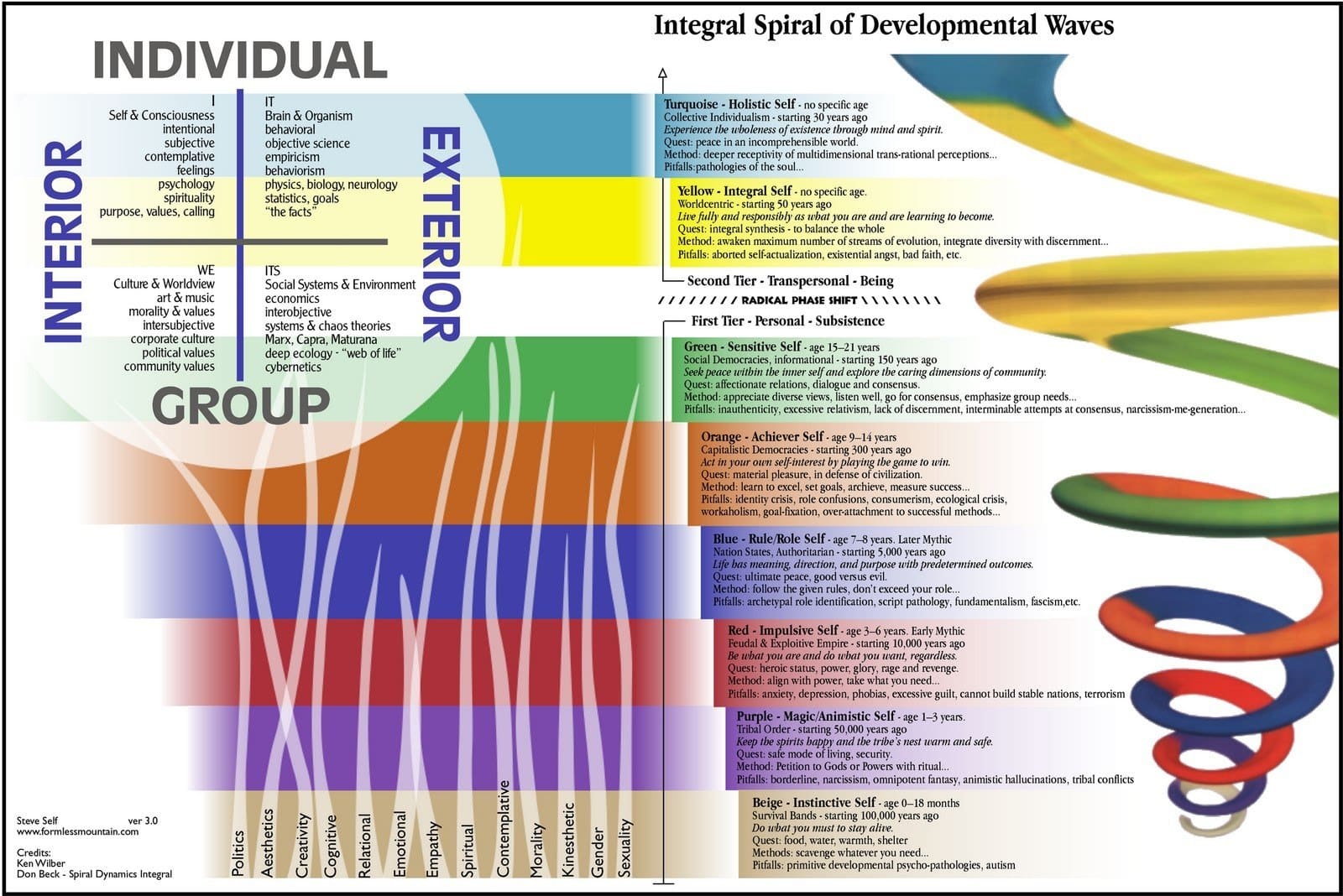
Spiral Dynamics, developed by Clare W. Graves and further refined by Don Beck and Chris Cowan, is a model of human development that aligns with Integral Theory. It describes the evolution of values, worldviews, and consciousness in individuals and societies. Spiral Dynamics represents these developmental stages through a color-coded system, with each color representing a particular level of consciousness and corresponding values.
- Beige: The Beige stage represents the earliest forms of human existence, focused on survival and meeting basic needs.
- Purple: The Purple stage is characterized by tribal and magical thinking, where individuals seek safety and belonging within a close-knit community.
- Red: The Red stage embodies a more egocentric and power-oriented mindset, emphasizing personal achievement, dominance, and expression.
- Blue: The Blue stage reflects a traditional and rule-based orientation, valuing authority, order, and conformity to moral codes.
- Orange: The Orange stage represents a rational and achievement-oriented mindset, emphasizing individual autonomy, success, and the pursuit of material wealth.
- Green: The Green stage embodies a pluralistic and egalitarian perspective, emphasizing equality, social justice, and environmental concerns.
- Yellow: The Yellow stage is characterized by a systemic and integrative worldview, recognizing the interconnections between different perspectives and seeking holistic solutions.
- Turquoise: The Turquoise stage represents a holistic and spiritual orientation, valuing interconnectedness, collective well-being, and planetary consciousness.
Spiral Dynamics suggests that individuals and societies can progress through these stages of development, with each stage building upon and transcending the previous ones. It recognizes that different value systems can coexist within a society, but individuals may predominantly operate from a particular stage.
Summary
Integral Theory, developed by Ken Wilber, offers a comprehensive framework for understanding human knowledge and experience. The AQAL model provides a four-quadrant perspective, examining individual and collective dimensions from subjective and objective viewpoints. Spiral Dynamics, a developmental model integrated within Integral Theory, identifies stages of consciousness and values in individuals and societies, recognizing the dynamic evolution of human perspectives.