In 2008, Edwin Korver embarked on a revolutionary journey with RoundMap to transform the customer development process. Challenged by the dynamic changes in social media and digitalization, Korver knew that the traditional linear funnel models used in marketing and sales were inadequate. His vision was to develop a more holistic and accurate approach to understanding customer engagement.
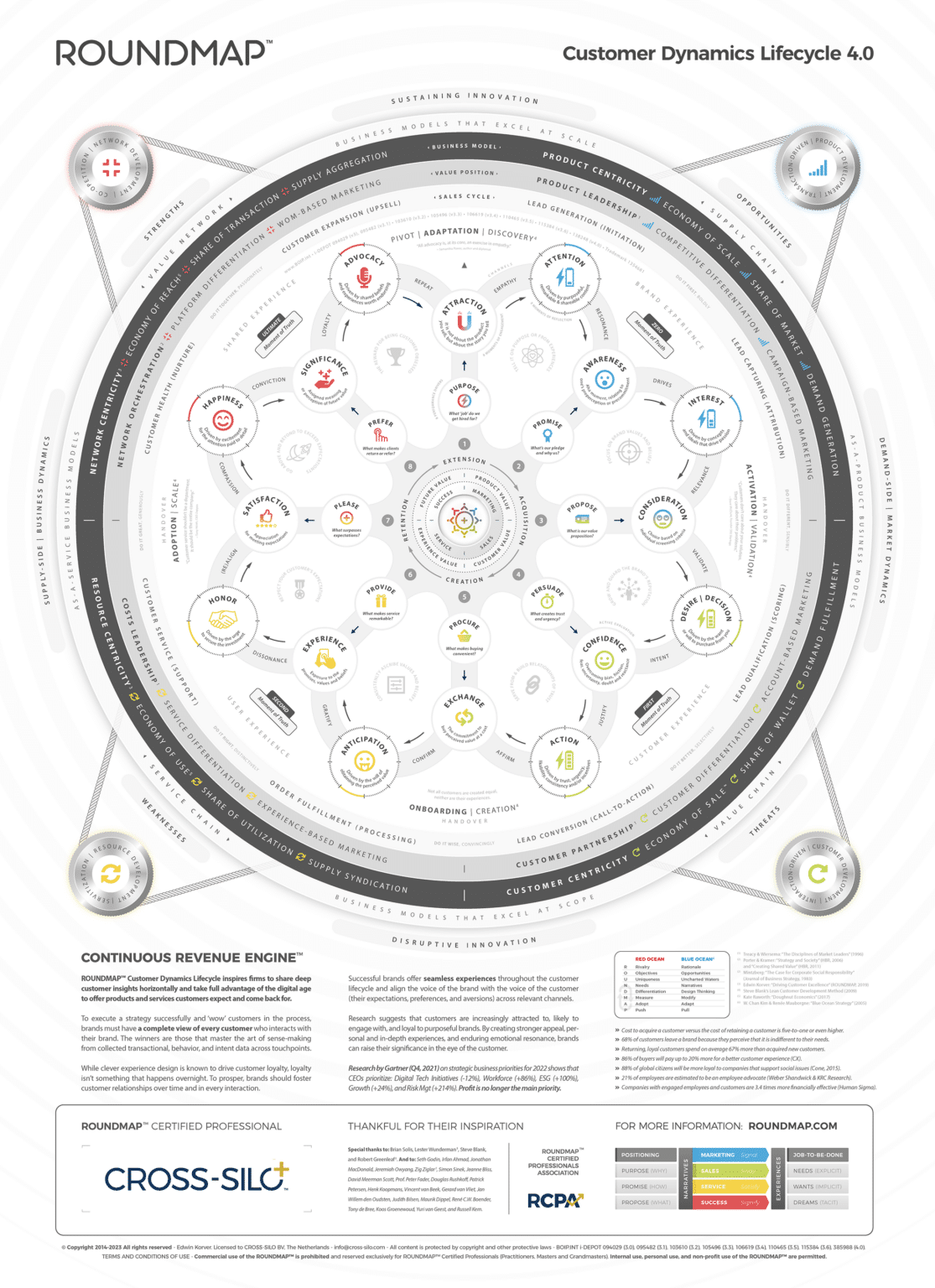
The groundwork for the RoundMap Framework is encapsulated in the Customer Lifecycle, available as a detailed PDF. We consider it the Ultimate Level of Truth™ because it underscores a fundamental business truth: success hinges on effective customer interactions. Renowned strategist Michael Porter echoes this sentiment, highlighting that all business activities ultimately support these frontline interactions.
Daunting at First Glance
At first glance, the Customer Lifecycle Map seems daunting. However, with guidance from a trained RoundMap Practitioner, its intricate design reveals a profound and comprehensive understanding of customer relationships.
The purpose of the RoundMap is multifaceted. It serves as a tool to enhance customer lifetime value, diagnose issues in customer satisfaction, understand purchasing hesitations, identify process inefficiencies, and uncover growth opportunities. In essence, it’s a versatile blueprint with countless applications.
While RoundMap simplifies the complexity of customer development into a manageable framework, it remains rich with emotional nuances. Successful implementation requires understanding buyer motivation, complemented by data insights into underlying emotions and motivations.
Who Benefits from Mapping the Customer Lifecycle?
It’s not limited to frontline staff. Per Porter’s Value Chain theory, practical implementation involves everyone from frontline to back office, integrating the entire value chain and broader stakeholder circle. This inclusive approach extends to anyone involved in customer development, whether directly or indirectly.
The Customer Lifecycle is universally applicable and suitable for both profit and non-profit scenarios. It facilitates continuous communication and engagement with all stakeholders – customers, patients, fans, citizens, visitors, or partners. Thus, it could also be aptly named the Stakeholder Lifecycle.
The “Customer Lifecycle” label underscores the primary goal of any business: to attract and retain customers, the cornerstone for creating value for stakeholders. It is a lifecycle because it embodies the collective responsibility of all team members, across all roles, to serve customers throughout their journey with the company. And it’s a map detailing each step of customer-frontline interaction.
How to use it?
The Customer Lifecycle Map is best utilized in a collaborative setting, ideally placed on a round table with participants from various roles involved in the customer process. The insights gained depend on your objectives, but often, the answers lie within your team’s collective knowledge. Creating an environment of psychological safety and encouraging open dialogue are key to unlocking these insights.
The map can also be used in role-playing scenarios, such as:
- Hosting customer roundtable discussions to gather feedback and expectations.
- Organizing team meetings to address specific frontline issues.
- Facilitating cross-functional story-sharing sessions to boost communication and collaboration.
- Encouraging role and function swapping to foster empathy and understanding.
- Tackling specific problems or discussing new customer attraction strategies.
- Preparing teams for marketing campaigns or change initiatives.
The Customer Lifecycle Map acts as a catalyst for open, constructive dialogue. Creating a safe space where everyone can speak freely is crucial to achieving the best results. This might require adherence to simple yet vital Roundtable rules.
Interested in Using the Customer Lifecycle Map?
Contact us to connect with a licensed RoundMap Practitioner near you.